Sunday, January 9, 2022

The 2021-2022 School Year (so far...)

The start of a new year, whether it is a new school year in September, or the January 1st new year, always forces me to reflect on how things in my life have been going, and how I want them to be moving forward.  And since we are officially one week into 2022, this is no exception.  I always feel a little bad for not blogging on here more, but I have also learned to give myself grace.  I am a full time public school teacher, during a pandemic, and mom to a toddler (also during a pandemic, might I add) and some most days/weeks, if I just get by without getting everything done on my to-do list, I have learned to be ok with that, even though it still feels sort of crummy.

I have two unfinished drafts of posts on here from August, right before the school year started up again, and one from last weekend, right as winter break was ending.  One of my personal goals/intentions/mantras for 2022 is to try to be a little bit better today than I was yesterday, so am telling myself that I will write on here and whatever I get to, I will publish, and I will be ok with it, because it will be better than yesterday, when I didn't post at all.

So what's new?  How are things going?
Like, most teachers, this year has been hard.  The period of time after the holidays until about spring break is always a hard time of year in school - it's dark, cold, the newness of the new year is long gone and June is even further away.  Add to that the COVID numbers are only going up lately, and everyday I cannot help but think that I will be the one to bring it home to my unvaccinated two year old, since my husband is still able to work from home.  Hard is putting it lightly.  But there have been some bright spots in teaching this year.  Here are some from our first week back last week...

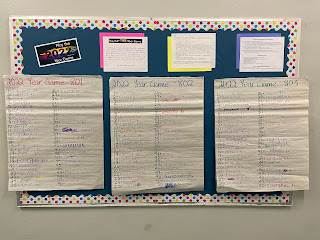
Monday & Tuesday, my 8th graders worked on the 2022 Year Game, which I always love doing with my students.  Although none of my classes were able to find all 100 numbers, it is always a fun way to come back to school after winter break (and makes an easy great first bulletin board of the new year).
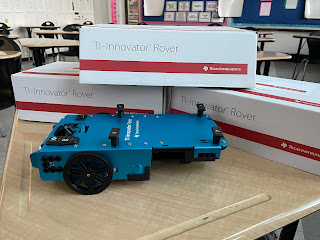

Also this week, the three TI Rovers that I was able to get for free thanks to the TI Technology Rewards Program earlier this year came in.  I was able to show them to my homeroom, and a few of the students were really interested in them.  Unfortunately they didn't come with the hubs, but luckily I was able to use some of my MfA Master Teacher stipend to pay for them.  With these three, plus the one that I already had, I will have four that I can use with students.  I hope to use them in both my 8th grade Algebra 1 classes, as well as my two 7th grade math team classes soon, and I am excited to really get into them.

Lastly, this week, I did something that I always say that I want to do more of, but unfortunately hadn't done this year - make two videos of me going over some regents questions on systems of linear equations for my 8th graders.  Again, trying to stick to my intention of trying to be a little bit better today than I was yesterday, I brought in my iPad to work on Thursday & Friday and recorded one video after school on Thursday going over Thursday's questions, and then again did the same on Friday, going over Friday's on Explain Everything, and even though they might not be perfect, I am proud of myself for pushing myself out of my comfort zone.  

Some of my goals for this upcoming week are to get better about supporting our quarantined students.  I'll be honest, just keeping up with who is just "absent" and who is "remote present" has been a struggle this past week, but I felt good at the end of last week posting my slides for the week, as well as a quick recap fo each day, and what work quarantined students should be turning in, and maintaining office hours for those students, I hope this week I can be a little bit better than last week.

Also, since I haven't posted since August, some of the other changes this school year have been that occasionally I am the site supervisor of my school.  I finally applied to get my initial School Building Leader certificate in 2018, after graduating from the Bank Street Leadership in Math Education program in 2012.  I still don't really see myself leaving the classroom, but with everything going on this year, when my principal asked me if I wanted to take on this role occasionally, I was definitely interested.  So far I have been the site supervisor three times this school year (including the day back from Thanksgiving break, the day of the viral possible school threats on Tik Tok, and the day before winter break. 

Last month I also got accepted into the New York State Master Teacher Program, as part of my Math for America Master Teacher II+ Fellowship, and I am excited to see what this dual citizenship will bring.  
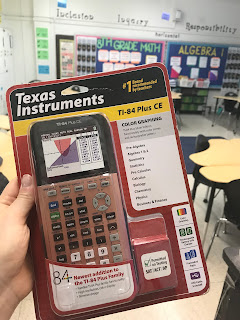
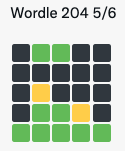
Finally, reading is one of the ways that I practice self care, and last year I read a mind-blowing 82 books.  I enjoy reading for fun, but I also enjoy learning something new from reading, and this year I would like to continue reading more, both for fun, and to grow as a teacher.  I am currently on my third "fun" book of the year, and started my first "teacher" book of the year, "Ungrading: Why Rating Students Undermines Learning."  I have been thinking about grading this year a lot, and especially after reading this article from Edutopia, "The Case Against Zeros in Grading".  I am only 10% done with it so far, and am looking forward to the rest.  Another thing I have enjoyed doing more of this year, is math problems, just for fun.  My students all participate in the Math Olympiad and Sigma Math Competitions, and doing more of these non-routine problems with my students has been fun.  On an unrelated note, over the winter break, my daughter discovered my graphing calculator, and one of her favorite things to do with it would be to sit on my lap, and tell me to graph something (usually an X or U) in a particular color (I have a rose gold TI 84+ CE) and after I input the equations, I tell her to press "graph" and then she'll say "let's see what happens" and both my mom heart & teacher heart just explode with joy!  She also learned how to play her first board game during the winter break (Candy Land) and oh yeah, she was potty trained, so it was a great week for her all around!  Lastly, something that I have enjoyed lately, is, yes, I have jumped on the Wordle bandwagon, and I don't want to brag or something, but since playing my first game on December 31st, I haven't lost yet.  It's been a fun way to spend a few minutes every day and obviously I want to keep my winning streak going. 


So that's what I have so far.  I am proud of myself for actually blogging on here and I hope that I can keep it going, moving forward.  I just need to remember that I don't have to be perfect today, I just have to try to be a little bit better than yesterday.

Tuesday, August 17, 2021

Building Thinking Classrooms Toolkit 1

The first toolkit in the Building Thinking Classrooms (BTC) Framework consists of three practices that need to be implemented simultaneously, rather than sequentially.  They are:

  1. Give thinking tasks
  2. Frequently form visibly random groups 
  3. Use vertical non-permanent surfaces
In Building Thinking Classrooms Peter Liljedahl states that "If we want our students to think, we need to give them something to think about - something that will not only require thinking but also encourage thinking."  In math classrooms this starts with highly engaging, non-curricular tasks (aka low floor-high ceiling tasks).  Liljedahl also emphasizes that we have to "go slow at first, in order to go fast."  This makes sense and also ties into what Sarah Carter wrote about in 2018 that we have to communicate with students from day one that "we do math everyday."  BTC has some great tasks after most chapters, so I think my next step, as I begin to think about the first few weeks of school is to do them myself.  The nice thing about NYC schools having one of the latest back to school dates in the country is that so many fellow MTBoS teachers have already started doing this with students.  A challenge I am anticipating is that using non-routine interesting problems for the first week or two of school is how I usually start the school year, and students seem to really enjoy them, and then the switch gets flipped and we start our first traditional unit, I think, for the most part, students (and parents) kind of expect that, but if I am committed to building a thinking classroom, I need to stop worrying about the curriculum.  Math is about problem solving, and problem solving takes time and can get messy.  In addition to the non-curricular tasks that are suggested in the book, I hope to use some from Sigma, Olympiad & MathCounts competitions, which my students have participated in since 6th grade as well of the problem solving resources that I have gotten through my MfA PLTs.

Forming visibly random groups is another practice that I tend to start the school year with.  My favorite method is to use two deck of cards (one with a card taped to each student desk, in groups) and hand the corresponding cards from the other deck to students as they walk into the classroom each day, so that they are not sitting in the same seats the first few days.  I have also done this my having each of my groups be labeled with a different Greek letter/symbol (Alpha, Beta, Delta, Theta, Pi & Sigma) and then handing each student a card with one of the symbols on it as they walk into the classroom.  My worry this year, is that last year, desks had to be in rows, 6 feet apart and sharing supplies was not allowed.  We are on track to start this year with 100% of students back in the classroom, but I worry about whether or not grouping will be allowed.  Also, again, this was a practice I would do during the first week or or so of school, until I created a seating chart, and if I am committed to BTCs, I will need to keep this practice up beyond September.

Lastly is using vertical non-permanent surfaces (VNPS) in my classroom.  I dabbled with something similar to this at my previous school a few years ago when I was trying out 360 Degree Math.  One of the things I love about MfA besides the pizza (at least when we could physically go there in person) was that almost every wall was a VNPS).  Unfortunately my classroom (on the 5th floor of a building with no elevator and no working AC) has a wall of lockers on one side and windows on the other, and the two walls that could be used for VNPs aren't really set up for it.  The other very real problem to consider is that in a typical school year, my students would come to my classroom, and last year, it was the teachers that traveled between classrooms, so I taught in several different classrooms, all with different set ups.  We don't have official guidance yet on whether students or teachers will be traveling, so this is something I have to really think about.  Based on what I've seen from other teachers Wipebook seems to be really popular.  Luckily being in MfA I get $2000 to spend on classroom supplies, so the money isn't an issue, although I would really only like to buy one class set instead of three or more, depending on how many different classrooms I will be teaching in this year. 

Slowly Getting Ready for the 2021-2022 School Year

I always have so many mixed feelings about this time of year.  We have been on summer break for seven glorious weeks now and have a little less than four weeks left before the school year starts up again.  Never has a summer break been more necessary than after the 2020-2021 school year.  I get exhausted even thinking about last school year & hope I never have to teach both in-person & via Zoom *at the same time* ever again.  I'm still not sure how we got through it all!  As we slowly begin to gear up for the 2021-2022 school year, there are a lot of mixed feelings... more than usual.  There is the usual excitement & hope that a new school year brings, but there is also a lot of fear & so many unknowns.  We know that the upcoming school year will not be a "typical" school year and we also know it won't be exactly like last school year, which makes planning for the upcoming school year challenging.  Something I am grateful for this upcoming year is that I will still have the support of the MfA community as I begin my second Master Teacher Fellowship.  In preparation for the new school year, I read Building Thinking Classrooms in Mathematics by Peter Liljedahl, after seeing so much buzz for it on the MTBoS, and it did not disappoint!  So many practical ideas about shifts we can make in our classrooms to support students in thinking about mathematics, all backed up with real classroom experience.
While reading each chapter, I found myself saying "Yes!  I need to do this!"  After the insanity of last school year (and for the first time in my career, not being totally excited to go back to who knows what last summer, it was nice to be excited about all the ideas in Building Thinking Classrooms, which tie into so many aspects of education that I have always wanted to grow in - from building a classroom environment that is more authentic in doing real mathematics (and more engaging to students), to implementing equitable grading practices that support students in their math learning.

As exciting as it was to read and highlight the heck out of my copy of Building Thinking Classrooms, and tell myself that I am going to 100% jump into this (which is very easy to say when the school year is still 3+ weeks away) I am nervous, that like so many other past ambitious goals for the upcoming school year, it will fizzle out, as the year goes on.  The good news is that since I am starting my second MfA fellowship this summer, I hope I can use that to motivate me to blog more on here and share my learning experience, both the successes and challenges in building my thinking classroom this year and hope I can use this space to hold myself accountable in trying new things and not letting this opportunity go.

The Building Thinking Classrooms Framework consists of fourteen factors that have been found to improve thinking in the math classroom (see the image on the right), in that order (1-3, 4-8, 9-11, and then 12-14), with each group being referred to as a toolkit.  In order to be thoughtful in my reflection (and not to overwhelm myself) I think I am going to break up each toolkit into a separate blog post.

Lastly, I want to begin to formally think about my 2021-2022 goals.  Sarah Carter of Math Equals Love recently posted her 2020-2021 goals update and back in January of this year, I reflected on my own 2020-2021 goals on here.  Here are my 2021-2022 goals so far.  They are still very much a work in progress, but I decided to make the first four goals the Building Thinking Classrooms toolkits.  I am going into my fifteenth year teaching, and like any good teacher, I want to get better at what I do, and I am excited to improve the Building Thinking Classroom practices that I already do, and implement the others.  Part of my involvement in MfA this year will also co-facilitating a year-long professional learning team on formative assessment lessons and the TRU Framework.  I think my goal of building a thinking classroom ties in really well with the TRU Framework and I am really excited to do this work!